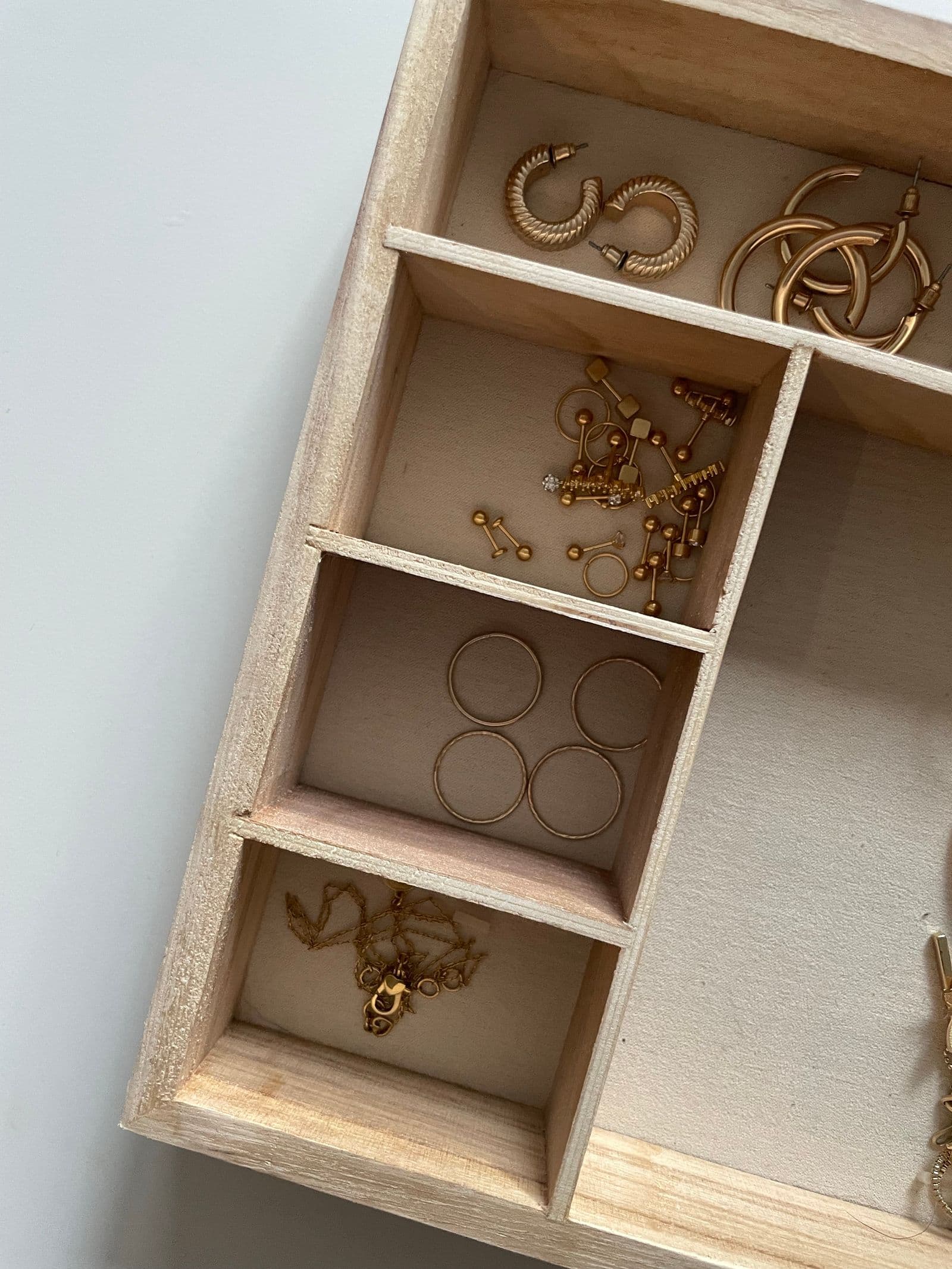
How to store jewellery so it lasts
Most plating damage happens in storage, not on the body. Air, friction and humidity — and how to stop all three.
Jewellery spends far more of its life in a drawer than on a neck, which is why storage does more damage than wear. Three things degrade a piece while you are not looking: air, friction and humidity. All three are easy to stop.
Air
Oxygen and airborne sulphur are what tarnish reacts with. An anti-tarnish seal slows this considerably, but the simplest additional defence is to keep pieces in a closed pouch or a lidded box rather than open on a tray. A resealable bag is unglamorous and works better than almost anything sold for the purpose.
Friction
This is the one people miss. Jewellery piled together in a single box rubs constantly every time the box moves, and plating wears at exactly the points where pieces touch. Give every piece its own pouch or compartment. If you keep only one habit from this article, keep this one.
Humidity
Bathrooms are the worst place in the house to store jewellery, and the most common. Steam and damp accelerate tarnish dramatically. Move it to a bedroom drawer. In a humid climate, drop a silica gel sachet into the box — the ones that come in shoeboxes work perfectly — and replace it every few months.
Chains specifically
- Fasten the clasp before storing. A closed chain cannot knot itself.
- Lay chains flat or hang them rather than coiling them.
- For travel, thread a chain through a drinking straw, or roll it in tissue.
What not to do
Do not store jewellery in cotton wool, which snags fine links. Do not use rubber bands or anything containing latex near plating; sulphur in rubber tarnishes metal quickly. And do not put a piece away still warm and damp from wear — give it thirty seconds with a soft cloth first.